Amyotrophic lateral sclerosis (ALS) is often referred to as "Lou Gehrig's Disease," and it is a progressive neurodegenerative disease that affects the nerve cells in the brain and the spinal cord. Motor neurons reach from the brain to the spinal cord and from the spinal cord to the muscles throughout the body. The progressive degeneration of the motor neurons in ALS eventually leads to their death. When the motor neurons die, the ability of the brain to initiate and control muscle movement is lost. This disorder is characterized by rapidly progressing weakness, muscle atrophy and fasciculations (twitches), muscle spasticity, difficulty speaking (dysarthria), difficulty swallowing (dysphagia) and a decline in breathing ability.
While in my second year of OT school I was in the process of learning about neurological disorders when I was shocked to hear a friend of my family was exhibiting some of the early symptoms of ALS. She was only 49 years old when friends and family started noticing how often she dropped things, tripped over carpets and entryways and often sounded like she was drunk. After driving 5 1/2 hours to the closest city, Edmonton (as in Alberta, Canada) and undergoing a few days of tests she received a definite diagnosis of ALS. A hard-working foster mother her whole working life, her and her husband were still raising two children and her ability to continue this hung in the balance. Fortunately her husband and some friends of the family were able to help with caring for the children but even at the end of her life she hadn't given up on them; she wasn't afraid to scold her children using her augmented alternative communication (AAC) device and some fierce facial expressions. I wasn't able to be a part of the Occupational Therapy she received after her diagnosis but I imagine her team focused on maximizing her speech, her safety in her mobility with equipment in the bathroom and shower and tried to optimize her ability to complete basic ADL as independently as possible.
It wasn't until a few years later that I encountered ALS as a practicing OT. I was working in a skilled nursing facility when I met a couple who had come in with separate but similar conditions (she had fallen and sustained a pelvic fracture, he was having falls as a result of a new diagnosis of ALS). They ended up moving into the long-term wing of the SNF to save money and to be together as much as possible. During his course of therapy I modified resting hand splints to prevent contractures from developing, the speech language pathologist (SLP) worked on an alphabet board and later a symbol board so he could communicate with staff and family and PT fit him for the right pair of ankle foot orthotics to prevent falls and Unna boots to prevent skin ulcers and pressure sores. We collaborated with the nurses and family members to help him maintain his quality of life but even after a feeding tube was placed he was still gone by the end of the year. And I have to admit that it was a relief when he passed on; he choked and coughed so often and so hard anyone could see it was a miserable way to live. But I will always be thankful that it was from him that I learned first hand how captivating and informative the human eyes can be; he had a hard time using his communication devices as his physical abilities deteriorated but he could still say a lot with his eyes if you took the time to see.
A few years later I saw my 2nd ALS patient. Now working in Home Health, I met the patient and her husband in their cosily decorated living room. Just weeks ago my patient had been diagnosed with ALS and her speech and swallowing abilities were already deteriorating. Fortunately she could still walk and transfer without any device or help and she held onto this ability for most of the time I worked with her. Having been diagnosed with early-onset dementia, she wasn't able to communicate with our team what her end of life wishes were. It fell to her husband to share with our team that their religious beliefs prevented them from using life prolonging medical procedures. That didn't make it any easier when I was visiting with the patient and her 20 year old daughter (the caregiver for the day) when she asked me what other patients do when they can't swallow. I described that a feeding tube is usually surgically placed and the patient receives their nutrition through a type of pump machine. She enthusiastically said "Well, that's what we'll do then!" and that's when I had to gently tell her that her parents had decided to let the disease run its course.
During my initial follow up visit I brought out a theraband, theraputty and instructed my patient's husband how the patient could use these tools to maintain her muscle strength but that once the neurons died there wasn't much we could do to bring those muscles back. I also brought out a raised toilet seat, and instructed her husband how their step-in shower with glass doors could be modified once she was no longer safe and independent with her mobility. I got to know her family quite well and during our sessions tried to teach her husband how to stretch out her left shoulder (previously injured by a damaged rotator cuff) so she could get dressed without pain. Her husband admitted that he never did the stretches on his own but was very appreciative of this work and often told me how much the patient enjoyed my visits. I believed him, even though while I was there after about 20 minutes she would always get up and leave the room to watch TV shows on her iPad. As I read note after note in the chart marveling at how many times my patient's husband had had to call the Emergency line for help because my patient just couldn't stop coughing I knew my treatment was coming to an end. And so, after only three months my patient was transferred from Home Health and Palliative Care Nursing (which helps people adjust to their new diagnosis) to Hospice (the patient has a prognosis of 6 months or less to live).
I don't know if my Home Health patient is still alive or if ALS has claimed her life but I am so thankful I was able to provide some support and comfort during such a challenging time in their lives. I don't usually forget my patients as a rule, but I know my ALS patients will continue to stay with me and that I continue to learn, usually with the patient and their family members, about how to best treat this destructive and complicated disorder.
Tuesday, July 10, 2012

Monday, June 4, 2012
Cranio Cradle to the Rescue!
I started having cervical neck pain after a patient fell while I was transferring him from a bed
to his wheelchair. It was an unexpected move and I wasn't ready so my upper Trapezius muscle ended up pulling my vertebrae out of alignment. This made my neck tighten up to the point where I could barely turn my head to shoulder check while driving.
I tried using a TENS unit at work, I went to an Acupuncturist, I had my Chiropractor friend manually adjust me at soccer and went for multiple massages. They all helped temporarily but I frequently would wind up re-injuring it at work or on the pitch. I eventually went to Physical Therapy, which helped address my wonky posture and forward head positioning, but it didn't address the neck muscle dysfunction.
I ended up complaining about the pain at work one day while I was working at another nursing facility and the other OT pulled me aside and explained he had had the same problem a few years ago. He explained to me that my neck muscles probably needed strengthening, that the reason I kept re-injuring myself was because my neck was too loose and needed more support. He encouraged me to start doing Shoulder shrugs with weights, Chest Pull exercises with a Thera-band and Chair dips. I started doing them that day and it started to help, my neck pain went away (after another adjustment from my friend, in his clinic this time) but it still felt tight and after I quit going to Massage therapy, I wanted something I could do on my own.
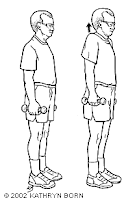 |
| Resisted Shoulder Shrugs |
 |
| Chest Pull |
 |
| Chair Dips |
I was introduced to the Cranio Cradle by a Myofascial Release therapist who recommended I get one to help release the fascia and tight muscles on my own time. I ordered it right away on Amazon and ordered a second one to gift to a friend who had always taken the time to help me with my neck! Check it out at http://www.craniocradle.com/
 |
| Cranio Cradle |
Friday, June 1, 2012
Tips for new OT Clinical Educators/Practioners
For the next six or eight weeks, you are the gatekeeper that will decide if your student will continue with their program and become a practicing OT. It is your responsibility so I would encourage you to take this as seriously as you would your own career.
1. Remember this is may be the first time your student may have encountered a smelly, nasty bowel movement, looked at an amputation, knelt in urine, and heard patients crying and screaming out in pain.
2. Encourage them to ask questions. Show them that when you ask the patient about their life and listen to the answer, it can distract you and them from an awkward situation (working around your first pair of elderly breasts or testicles) and it helps build the bond you will use to educate, support and push your patient.
3. Try to be open to your student asking questions, in fact encourage it! Remind them that an engaged student should have questions; about your approach, your thoughts, what they are seeing and even how they might have handled a situation or patient. Keep in mind this is an opportunity for you to learn too, don't be immediately defensive.
4. Remind them that most clinicians like to hear themselves talk. Give them time in their day to talk to the other clinicians, aides, nurses, doctor, administration - one day that information will come in handy for them, as it did for you.
5. Remember your student will be slow at everything, but especially documentation; it may take them an hour to write a note you'd finish in 10 minutes so schedule your time accordingly. Here's where it pays to be an organized clinician, something else you can model to your student.
6. When your student is actively participating in treatments and evaluations give them space afterward to ask for feedback about your time together. Try to stay positive when you do give feedback and use the 2 positives, 1 negative sandwich rule if possible.
7. Hopefully your student won't do this but most of the students I've worked with and seen at work have cried at some point in their time as a student. If your student does cry, try to stay neutral and listen to them, find out what is going on and offer to help.
8. If your student, even your first one, is endangering patients or putting the other employees at risk don't be afraid to go to their supervisor and communicate your concerns. You are the gatekeeper to our profession and so should act like one.
9. Most importantly...you are the clinician...so act like one! Ask your supervisor or other clinicians for help if you are feeling overwhelmed as having a student can be an amazing experience or a stint in hell!
1. Remember this is may be the first time your student may have encountered a smelly, nasty bowel movement, looked at an amputation, knelt in urine, and heard patients crying and screaming out in pain.
2. Encourage them to ask questions. Show them that when you ask the patient about their life and listen to the answer, it can distract you and them from an awkward situation (working around your first pair of elderly breasts or testicles) and it helps build the bond you will use to educate, support and push your patient.
3. Try to be open to your student asking questions, in fact encourage it! Remind them that an engaged student should have questions; about your approach, your thoughts, what they are seeing and even how they might have handled a situation or patient. Keep in mind this is an opportunity for you to learn too, don't be immediately defensive.
4. Remind them that most clinicians like to hear themselves talk. Give them time in their day to talk to the other clinicians, aides, nurses, doctor, administration - one day that information will come in handy for them, as it did for you.
5. Remember your student will be slow at everything, but especially documentation; it may take them an hour to write a note you'd finish in 10 minutes so schedule your time accordingly. Here's where it pays to be an organized clinician, something else you can model to your student.
6. When your student is actively participating in treatments and evaluations give them space afterward to ask for feedback about your time together. Try to stay positive when you do give feedback and use the 2 positives, 1 negative sandwich rule if possible.
7. Hopefully your student won't do this but most of the students I've worked with and seen at work have cried at some point in their time as a student. If your student does cry, try to stay neutral and listen to them, find out what is going on and offer to help.
8. If your student, even your first one, is endangering patients or putting the other employees at risk don't be afraid to go to their supervisor and communicate your concerns. You are the gatekeeper to our profession and so should act like one.
9. Most importantly...you are the clinician...so act like one! Ask your supervisor or other clinicians for help if you are feeling overwhelmed as having a student can be an amazing experience or a stint in hell!
Sunday, May 27, 2012
Myotonic Dystrophy and OT
Myotonic dystrophy affects approximately 1 in 8,000 people worldwide. The incidence of the two types of myotonic dystrophy varies among geographic and ethnic populations. In most populations, Type 1, the congenital form, appears to be more common than Type 2, a milder childhood-onset form. Myotonic dystrophy can occur in patients of any age. Both forms of the disease display an autosomal dominant pattern of inheritance. Type 1 patients often have myotonia (muscles that won't relax), daytime sleepiness, dysphagia (difficulty swallowing), disabling weakness in their extremities and severe cognitive problems. Type 2 patients commonly have muscle pain, stiffness, fatigue, daytime sleepiness and the development of lower extremity weakness.
Physical and Occupational Therapists as well as Speech Language Pathologists (SLP) are usually brought in to help manage the patient's condition. Either in the hospital, an acute rehabilitation centre or at home PT and OT assist the patient to participate in strengthening and aerobic training at a moderate intensity to increase muscle strength, promote heart and lung function, as well as maintain mobility.
Patients may need an ankle foot orthosis to help support their ankle joint, as the muscles surrounding this joint are often affected, making the patient at risk for falls. Other orthotics to promote hand function and prevent neck pain can be prescribed and fit to the patient. SLP's focus on improving the patient's ability to chew and swallow, as those muscles tend to be affected, putting the patient at risk for choking and aspirating food and liquids.
.jpeg)
Once the gloves arrived we started my patient on a wearing schedule that she could tolerate (from 10 minutes three times a day working up to 30 minutes, three times a day) and she was so happy to finally have the right tool (again) to help maintain the range of motion and flexibility of her fingers for grasping and manipulating.
So to all the other OT's out there in the Interweb universe, if you are stuck on how to help your patient who has Myotonic Dystrophy, or any other neurological disorder with rigid or contracted fingers in extension, don't forget about the Finger Flexion Glove!
Physical and Occupational Therapists as well as Speech Language Pathologists (SLP) are usually brought in to help manage the patient's condition. Either in the hospital, an acute rehabilitation centre or at home PT and OT assist the patient to participate in strengthening and aerobic training at a moderate intensity to increase muscle strength, promote heart and lung function, as well as maintain mobility.
 |
| Ankle Foot Orthosis (AFO) |

Patients with Myotonic Dystrophy also struggle with visual impairments and upper and lower extremity weakness so often OT's train them in the use of adaptive equipment and mobility aids, such as a long handled reacher and long handled sponge so the patient can independently complete item retrieval, dressing and bathing.
 |
| Leg Lifter, Shoehorn, Reacher, Sponge, Sock Aide, Elastic Shoelaces |
I met my first patient with Myotonic Dystrophy a few months ago and her particular set of difficulties stuck with me. She had been diagnosed with Type 1 Myotonic Dystrophy and over the last few years had started to struggle with maintaining her weight, her mobility and her independence. Slowly but surely her muscles just weren't responding to her commands; the fingers of her left hand were almost completely rigid in what looked like swan deformities and her right hand was starting to go that way too.
.jpeg)
She already had twenty four hour caregivers who helped her with dressing, bathing, grooming as well as with the more challenging activities of daily living, so after dutifully recommending bathing equipment that would make her more independent (and her refusing to try any of them) I moved on. I turned my attention to the contractures that were developing in both her hands.
-201277-PRODUCT-MEDIUM_IMAGE.jpg) |
| Resting Hand Splint |
Usually what we recommend for neurological conditions that affect the muscles in the hand and wrist is a resting hand splint that will keep the digits and wrist in a neutral position so that over time the contractures don't worsen (but they also aren't likely to improve unless we add a dynamic splint).
In this case however, I knew the resting hand splint wouldn't be enough to address each digits contractures at the PIP and DIP joints (proximal interphalangeal middle joints of the fingers and distal interphalangeal or tips of the fingers). So my search continued...
In this case however, I knew the resting hand splint wouldn't be enough to address each digits contractures at the PIP and DIP joints (proximal interphalangeal middle joints of the fingers and distal interphalangeal or tips of the fingers). So my search continued...
I stumbled across a medieval looking device as I was perusing the contracture management devices on the website of Medical Supplier Sammons and Preston. During my next visit I proudly showed my patient the picture I had downloaded from the Internet, thinking I had just elevated myself to Super OT. Instead she said, "Oh the Finger Flexion Glove?" and nodding knowingly. She then asked her caregiver to go look in her bedroom closet, and lo and behold the caregiver came back with a glove that looked very similar to the one I had found online. My patient explained that she had used these gloves at least 15 years ago when she was living in Chicago and she had completely forgotten about it. Her gloves were unfortunately missing a crucial part, the anchor where the elastics are tethered to provide traction on the digits. After problem solving with the caregiver about various ways we could adapt her existing glove, we found a pair online for $30.24 and my patient ordered them right on the spot.
 |
| Finger Flexion Glove |
Once the gloves arrived we started my patient on a wearing schedule that she could tolerate (from 10 minutes three times a day working up to 30 minutes, three times a day) and she was so happy to finally have the right tool (again) to help maintain the range of motion and flexibility of her fingers for grasping and manipulating.
So to all the other OT's out there in the Interweb universe, if you are stuck on how to help your patient who has Myotonic Dystrophy, or any other neurological disorder with rigid or contracted fingers in extension, don't forget about the Finger Flexion Glove!
[edit]
Wednesday, May 16, 2012
Graft-Versus-Host Disease and OT
There is an acute version of the disease, which usually happens up to three months post transplant, and a chronic version starts after three months post transplant. Some common acute symptoms include abdominal pain/cramps, diarrhea, fever, jaundice, skin rash, vomiting, weight loss and more chronic symptoms include dry eyes and mouth, hair loss, hepatitis, lung and digestive tract disorders, skin rash and skin thickening. The treatment for GVHD is still changing as research continues to show the benefit of using different combinations of drugs or steroids but generally it is treated with the administration of Cyclosporine, Methotrexate, Tacrolimus, Sirolimus or Prednisone, which all weaken the donor T-cells enough so they don't attack the patient's organs and tissues. Unfortunately the side effects of these drugs can cause some very extreme changes in the patients emotional and physical state. Depression, confusion, anxiety and roller-coaster emotions can make it difficult for the patient and their family or support system.
I must have looked a little shocked at this statement because she explained to me that she had been doing a lot of soul searching on their situation and she thought that this was happening to him for a reason. She pointed out that the love of his life was his work and that slowing down to spend time with her and their children was something she wanted for him but was afraid it wasn't something he was capable or interested in doing. As I digested this, I recommended they replace their flimsy towel bars with grab bars, install arms on the toilet and place a vertical grab bar inside the shower to assist the patient with getting in and out more safely. She wrote this all down and went to get the patient, who grudgingly came into the bathroom. Knowing that he was likely to resist any changes if they were for him I tried to couch my recommendations in that the equipment would come in handy for when their parents or other elderly people visited them. He went along with everything I said, nodding as we went, until his spouse pointed out that their parents were too frail to visit anymore, but that this equipment would help him a lot. This statement challenged the patients belief that he was healed and I knew what was coming. The patient abruptly refuted everything he had just agreed with and I felt the momentum of the visit slip through my fingers. Angry at his wife and me, he refused to participate in range of motion, manual muscle testing or other assessments, saying he was too tired and that he had already done all of this with the PT. I respectfully backed off and offered that I could play a consultant role his his Home Health therapy and they could call with questions or concerns. We somewhat formally shook hands and I gathered my things to leave. Although I hope he was happy with this agreement, I know he was even happier to see me leave.
So it turns out patients with GVHD are just like any other patients. They are reluctant to believe their body is failing them, they lack insight into their own abilities and they cling to the roles and responsibilities of their previous jobs or hobbies. All we can do in these tough cases is support the family and caregivers, recommend the equipment that the patient will likely never purchase and wait by the phone in case we are needed.

Subscribe to:
Posts (Atom)