Showing posts with label PT. Show all posts

Monday, June 4, 2012

Cranio Cradle to the Rescue!

I started having cervical neck pain after a patient fell while I was transferring him from a bed 
to his wheelchair.  It was an unexpected move and I wasn't ready so my upper Trapezius muscle ended up pulling my vertebrae out of alignment.  This made my neck tighten up to the point where I could barely turn my head to shoulder check while driving.

I tried using a TENS unit at work, I went to an Acupuncturist, I had my Chiropractor friend manually adjust me at soccer and went for multiple massages.  They all helped temporarily but I frequently would wind up re-injuring it at work or on the pitch.  I eventually went to Physical Therapy, which helped address my wonky posture and forward head positioning, but it didn't address the neck muscle dysfunction.

I ended up complaining about the pain at work one day while I was working at another nursing facility and the other OT pulled me aside and explained he had had the same problem a few years ago.  He explained to me that my neck muscles probably needed strengthening, that the reason I kept re-injuring myself was because my neck was too loose and needed more support.  He encouraged me to start doing Shoulder shrugs with weights, Chest Pull exercises with a Thera-band and Chair dips.  I started doing them that day and it started to help, my neck pain went away (after another adjustment from my friend, in his clinic this time) but it still felt tight and after I quit going to Massage therapy, I wanted something I could do on my own.
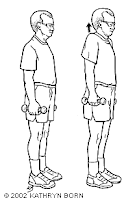
Resisted Shoulder Shrugs
Chest Pull
Chair Dips
I was introduced to the Cranio Cradle by a Myofascial Release therapist who recommended I get one to help release the fascia and tight muscles on my own time.  I ordered it right away on Amazon and ordered a second one to gift to a friend who had always taken the time to help me with my neck!  Check it out at http://www.craniocradle.com/

 
Cranio Cradle

Sunday, May 27, 2012

Myotonic Dystrophy and OT

Myotonic dystrophy affects approximately 1 in 8,000 people worldwide. The incidence of the two types of myotonic dystrophy varies among geographic and ethnic populations. In most populations, Type 1, the congenital form, appears to be more common than Type 2, a milder childhood-onset form.  Myotonic dystrophy can occur in patients of any age.  Both forms of the disease display an autosomal dominant pattern of inheritance.  Type 1 patients often have myotonia (muscles that won't relax), daytime sleepiness, dysphagia (difficulty swallowing), disabling weakness in their extremities and severe cognitive problems. Type 2 patients commonly have muscle pain, stiffness, fatigue, daytime sleepiness and the development of lower extremity weakness.

Physical and Occupational Therapists as well as Speech Language Pathologists (SLP) are usually brought in to help manage the patient's condition.  Either in the hospital, an acute rehabilitation centre or at home PT and OT assist the patient to participate in strengthening and aerobic training at a moderate intensity to increase muscle strength, promote heart and lung function, as well as maintain mobility.  

Ankle Foot Orthosis (AFO)
Patients may need an ankle foot orthosis to help support their ankle joint, as the muscles surrounding this joint are often affected, making the patient at risk for falls.  Other orthotics to promote hand function and prevent neck pain can be prescribed and fit to the patient.  SLP's focus on improving the patient's ability to chew and swallow, as those muscles tend to be affected, putting the patient at risk for choking and aspirating food and liquids.


Patients with Myotonic Dystrophy also struggle with visual  impairments and upper and lower extremity weakness so often OT's train them in the use of adaptive equipment and mobility aids, such as a long handled reacher and long handled sponge so the patient can independently complete item retrieval,  dressing and bathing.
                       
                   Leg Lifter, Shoehorn, Reacher, Sponge, Sock Aide, Elastic Shoelaces


I met my first patient with Myotonic Dystrophy a few months ago and her particular set of difficulties stuck with me.  She had been diagnosed with Type 1 Myotonic Dystrophy and over the last few years had started to struggle with maintaining her weight, her  mobility and her independence.  Slowly but surely her muscles just weren't responding to her commands; the fingers of her left hand were almost completely rigid in what looked like swan deformities and her right hand was starting to go that way too. 


She already had twenty four hour caregivers who helped her with dressing, bathing, grooming as well as with the more challenging activities of daily living, so after dutifully recommending bathing equipment that would make her more independent (and her refusing to try any of them) I moved on.   I turned my attention to the contractures that were developing in both her hands.  


Resting Hand Splint
Usually what we recommend for neurological conditions that affect the muscles in the hand and wrist is a resting hand splint that will keep the digits and wrist in a neutral position so that over time the contractures don't worsen (but they also aren't likely to improve unless we add a dynamic splint).  

In this case however, I knew the resting hand splint wouldn't be enough to address each digits contractures at the PIP and DIP joints (proximal interphalangeal middle joints of the fingers and distal interphalangeal or tips of the fingers).  So my search continued...

I stumbled across a medieval looking device as I was perusing the contracture management devices on the website of Medical Supplier Sammons and Preston.   During my next visit I proudly showed my patient the picture I had downloaded from the Internet, thinking I had just elevated myself to Super OT.  Instead she said, "Oh the Finger Flexion Glove?" and nodding knowingly.  She then asked her caregiver to go look in her bedroom closet, and lo and behold the caregiver came back with a glove that looked very similar to the one I had found online.   My patient explained that she had used these gloves at least 15 years ago when she was living in Chicago and she had completely forgotten about it.  Her gloves were unfortunately missing a crucial part, the anchor where the elastics are tethered to provide traction on the digits.  After problem solving with the caregiver about various ways we could adapt her existing glove, we found a pair online for $30.24 and my patient ordered them right on the spot.

Finger Flexion Glove
 
 Once the gloves arrived we started my patient on a wearing schedule that she could tolerate (from 10 minutes three times a day working up to 30 minutes, three times a day) and she was so happy to finally have the right tool (again) to help maintain the range of motion and flexibility of her fingers for grasping and manipulating.


So to all the other OT's out there in the Interweb universe, if you are stuck on how to help your patient who has Myotonic Dystrophy, or any other neurological disorder with rigid or contracted fingers in extension, don't forget about the Finger Flexion Glove!


[edit]